The floor starts from what you want to take home: floor = take-home × 1.15 ÷ (weekly hours × 4.33 × billable share). The 1.15 covers tax, tools, and savings. 4.33 is the average number of weeks in a month. The billable share is the part of your hours you can invoice: 65% by default, and you can set 40% to 90%. There is no hidden extra buffer and no country multiplier.
For example, EGP 30,000 take-home and 25 hours a week at 65%: 25 × 4.33 = about 108.3 hours on the calendar, and 65% of that is about 70.4 hours you can invoice. 30,000 × 1.15 = 34,500, and 34,500 ÷ 70.4 gives a floor of about EGP 490 an hour.
Until you type your own take-home, the calculator starts it at what the low end of the market band earns at your hours, so the floor starts at the bottom of the market. Type your real take-home to see your own floor.
The quote is the market rate for your experience: Junior takes the low end of the band, Mid-level the typical value, and Senior the high end. If your floor is above that, the quote is your floor. With no market band, the quote is the floor plus 15%, so there is room to negotiate down to the floor. The quote is never below the floor.
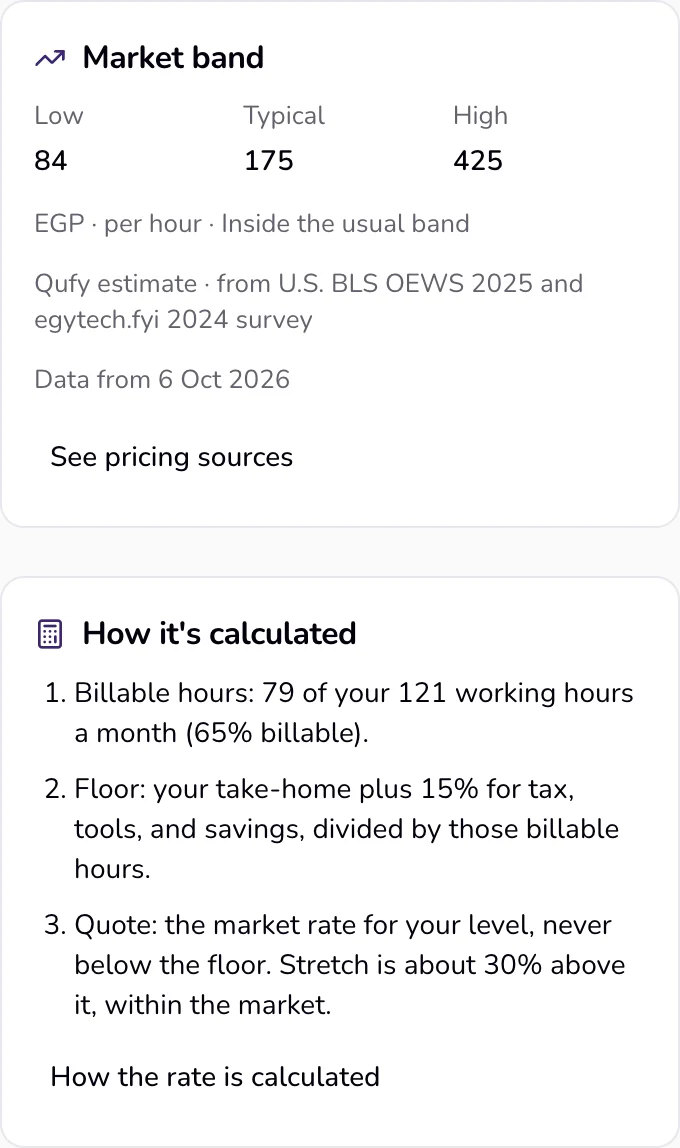
Stretch is the quote × 1.3, but not above the top of the market band; it is always at least the quote × 1.15. For example, a mid-level UI/UX designer in Egypt (band EGP 84 / 175 / 425 per hour, 28 hours a week, default take-home) gets Floor 84, Quote 175, and Stretch 230.
Steps
- 1
Fill in the rate calculator at /rate.
- 2
Read “Market band” and “How it's calculated” beside the form (under it on a phone).
- 3
In “How it's calculated”, read the three lines: your billable hours a month, how the floor is worked out, and how the quote and stretch follow.
- 4
In “Market band”, read the “Low”, “Typical”, and “High” rates per hour and where your quote sits: “Below the usual band”, “Inside the usual band”, or “Above the usual band”.
- 5
Press “See pricing sources” to open /sources and see where each band comes from.
Good to know
- Day rate = hourly rate × 6, because a billed day is 6 hours. Charging by the day counts the project hours ÷ 6, rounded up to whole days.
- Package = hourly rate × project hours (at least 8), plus “Scope buffer (10%)”. A package is never less than 8 hours at your rate plus that 10%. Charging by the hour is simply hourly rate × project hours, with no buffer.
- Revision rounds: the first round is inside the 10% buffer. Each extra round (up to 3 in total) adds 10%, on a package or a day rate.
- Rounding: USD rates are rounded to whole dollars. Other currencies are rounded to the nearest 5 when the amount is 100 or more, otherwise to a whole number.
- The market band needs a profession, chosen in “Your numbers”. Without one, “Market band” reads “Pick a profession to load a market band.” and the quote is the floor plus 15%.
- “Below the usual band” means your quote is under 95% of the band’s low end. “Above the usual band” means it is over 105% of the high end. Anything between is “Inside the usual band”. The band never pushes your quote below your floor.
- Where the bands come from: every country uses one method for every profession. International / U.S. uses U.S. occupation pay from the BLS as it is. Egypt, Saudi Arabia, and the UAE each have one local source for developer pay: the egytech.fyi 2024 survey for Egypt, and the SearchGulfTalent guide (May 2026) for Saudi Arabia and the UAE.
- In those three countries, Qufy divides local developer pay by U.S. developer pay at the low, typical, and high points. Every profession’s U.S. pay is multiplied by the same three ratios. So a developer gets the local figure, and the other professions keep the U.S. order: developer, UI/UX & web designer, consultant, writer, video editor, graphic designer, photographer. Designers are two professions in Qufy: a graphic designer uses U.S. pay for graphic designers, and a UI/UX & web designer uses U.S. pay for web and digital interface designers, which is higher. In the U.S. data, writers earn more than graphic designers, so the writer band is above the graphic designer band.
- Under the band you see its sources and the date of the data. “Qufy estimate” means the band is scaled, not measured. Only two kinds of band are not labelled that way: International / U.S. (straight from the BLS) and developers in Egypt (straight from egytech.fyi). Developer bands in Saudi Arabia and the UAE are labelled “Qufy estimate” too, because the SearchGulfTalent guide publishes no method or sample size.
- Be aware: every band starts from employee pay, not from freelance invoices. Qufy turns the monthly pay into an hourly figure (monthly ÷ (40 × 4.33)) and applies a freelance load of 1.5 on the low end, 1.6 on the typical value, and 1.8 on the high end. Treat the band as a check, not as what clients in your market pay today. /sources lists each source, its date, and its limits.
Last updated 6 Oct 2026
Was this helpful?